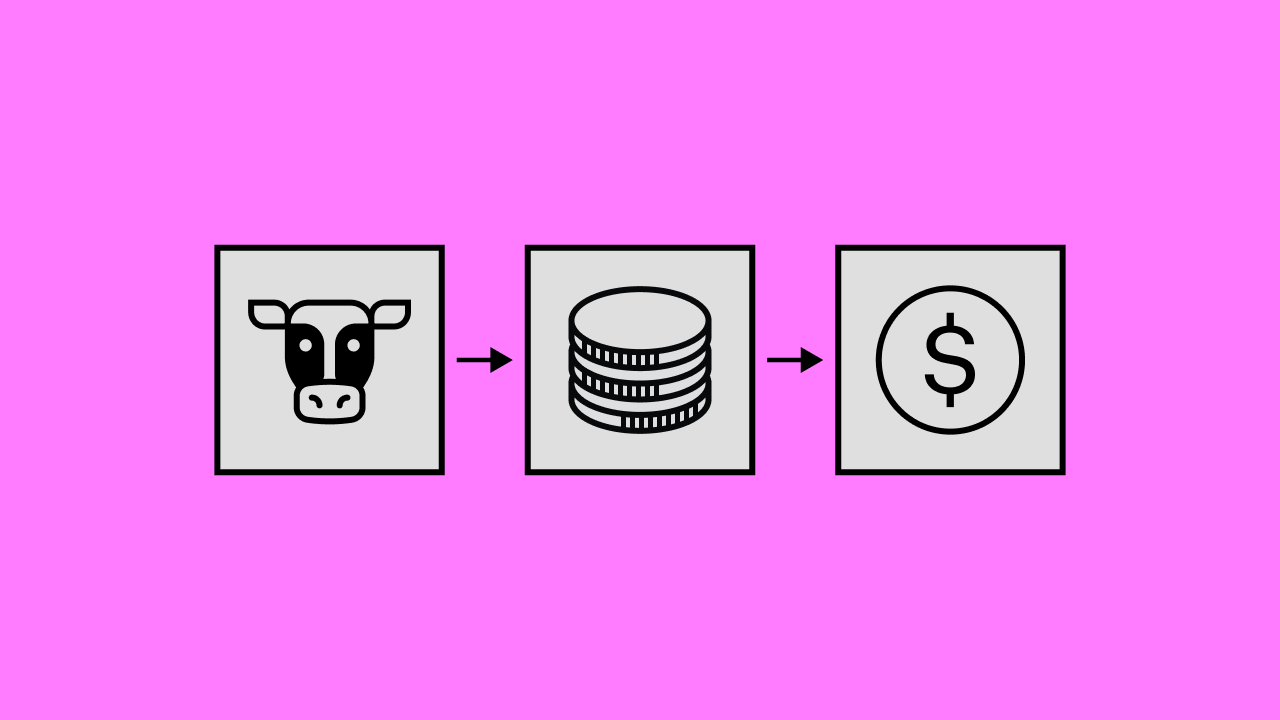
Why did Brazilian farmers just tokenize their cows?
There’s never a dull moment onchain. Here’s what you need to know this week:
The Fed held rates steady, but three members voted to hike. With September's meeting now in focus, what does it mean for crypto?
BlackRock, Goldman Sachs, and Fidelity just backed the CLARITY Act. With the Senate's summer recess days away, here's what's at stake.
Brazilian farmers just tokenized their cows. It sounds absurd — but it reveals something important about where tokenization is actually headed.





MARKET BYTES
Bitcoin remains steady as Fed holds interest rates for fifth meeting in a row
The Federal Reserve’s Open Markets Committee meets eight times a year to set interest rates — and before each of the last four meetings, markets had a clear consensus opinion that rates would remain stable.
Coming into this week’s meeting, however, traders were more split than usual, with around a 35% chance of a rate hike, according to CME futures.
But in the end, the Fed held rates steady for the fifth meeting in a row, citing a mixed picture with economic activity expanding at “a solid pace” but increased uncertainty due to higher energy prices arising from the continuing Iran conflict. Three of the twelve committee members dissented, and were in favor of a rate hike.
Bitcoin, which had fallen as low as $63,600 in the day before the meeting, recovered to $64,600 at the time of the announcement before dipping back below $64,000. (As a general rule, crypto traders see falling interest rates as a bullish signal because the combination of cheaper borrowing and lower returns on cash holdings tend to mean more capital flows to asset classes like stocks and crypto.)
The move left all eyes on September’s meeting. “We’re going to have an interesting set of data points come out between now and the September meeting,” said Jerry Templeman, a former senior analyst at the New York Fed and vice president of economics and fixed income research at Mutual of America Capital Management. “So, I don’t think that we’re going to necessarily be in the same position that we are today.”
Here’s more news you should know…
Goldman Sachs, BlackRock among Wall Street giants now backing the CLARITY Act
With just a little more than a week before the Senate breaks for the summer, a group of Wall Street’s biggest firms — including BlackRock, Fidelity, Franklin Templeton, Goldman Sachs, and SoFi — have urged the rapid passage of the landmark crypto regulation package.
The move added broad Wall Street support to a law that also has the backing of many of the biggest consumer tech companies in the world (including Apple, Amazon, Google, and Sony) and more than 200 top crypto firms and advocacy organizations (including Coinbase, Ripple, and Circle).
"Durable rules for digital assets are critical for U.S. global competitiveness," said SoFi CEO Anthony Noto. "It protects consumers and lets us build safely under homegrown regulation. Congress should pass it immediately."
The CLARITY act would answer some of the major questions hanging over the crypto industry. It would define the Commodities and Futures Trading Commission (CFTC) as the agency overseeing crypto markets, codify the right to self-custody of crypto assets, and create legal definitions for key crypto terms including “mature blockchain” and “digital commodity.”
Clear favorite?… As of Tuesday afternoon, nearly 60% of prediction market traders say that the Senate will vote on the CLARITY act before the summer recess. Assuming the bill gets the 60 votes it needs in the Senate, it goes back to the House, where leadership has pledged to move quickly — and then to President Trump’s desk to be signed into law.
Morgan Stanley launches new low-fee ETH and Solana staking ETFs
Earlier this year, Morgan Stanley launched a new spot bitcoin ETF, and even though it appeared during a rough bear market, it accrued around $400 million in assets under management in just four months, partly because of the low fees the firm charges holders.
This week, the Wall Street giant — which has around $14 billion under management — has launched new low-fee ETFs for Ethereum and Solana. Both funds will stake a portion of the crypto they hold and share some of the rewards with fundholders.
In bigger-picture ETF news, bitcoin ETFs’ recent run of momentum encountered some turbulence late last week, with around $465 million in outflows across July 23 and July 24, according to Bloomberg.
What shook ETF markets?... “We expect macro-driven uncertainty to persist this week, but our outlook on Bitcoin remains structurally bullish,” said Ivan Lim, a senior derivatives trader at FalconX. “The recent Bitcoin ETF outflows and fragile mood are largely a reaction to legislative waiting around the Clarity Act and faster Fed rate hike expectations.”
TOKEN EFFORT
Everything is becoming tokenized. Even … cows?
For a couple of years, one of the biggest stories in crypto has been the tokenization of real-world assets. It started with tokenizing stocks, bonds, and treasury bills. Now? It's expanding to livestock and business invoices — and as the utility of creating digital, blockchain-based tokens to represent pretty much any real-world asset continues to be unlocked, we appear to be inching closer and closer to the “tokenization of all assets.”
Here’s what you need to know.
The majority of financial firms see tokenization as a priority
A recent poll of 200 North American financial firms found that 84% of respondents called tokenization a “strategic priority,” highlighting the speed at which interest in the sector has exploded in recent years. Around 70% of respondents to the survey from Broadridge also said they believe tokenization will reshape financial markets within the next three to five years and nearly a third said they plan to increase investment in tokenization by up to 50% over the next two years.
Initiatives like BlackRock’s onchain tokenized Treasury fund, Franklin Templeton’s tokenized money market fund, JPMorgan’s blockchain platform Kinexys, and pilots from Visa and the DTCC around tokenized payments and securities are examples of significant industry adoption.
“Across the industry, there is clear recognition that tokenization has the potential to reshape how assets are issued, traded, financed, and serviced,” said German Soto Sanchez and Mark Nichols, co-presidents of Digital Assets at Broadridge.
Brazilian farmers are tokenizing their cows
A group of farmers in Parana, Brazil were struggling to get bank loans amid new restrictions that had been imposed on small agricultural businesses. So they turned to a novel solution – tokenizing their cows and putting them up for trade on the stock exchange, allowing them to be used as loan collateral.
"We take the cow, which is a real and tangible asset, and transform it into a digital asset backed by a unique code monitored in real time,” said Thiago Martins of Cowmed, a Brazilian agriculture-tech firm. “The process is simple and gives the producer an advantageous opportunity to finance themselves, opening a new alternative for collateral at a time of strong credit restrictions in agribusiness."
The cows are equipped with AI-powered collars that track their location, behavior, and health, and are part of a group of more than 100,000 cows being monitored by Cowmed. The first 10 tokenized dairy milk cows have already unlocked around $20,000 in loan capital for the farmers. As adoption grows, Cowmed expects around 20% of its $395 million herd to move toward tokenization, which could unlock more than $77 million in credit for the farmers.
The tokenized dairy cows are a world first, but they highlight the potential for any real-world asset to be turned into a tradeable token. By 2030, McKinsey & Company estimates that tokenized assets could be worth up to $4 trillion, up from around $36 billion today.
A South Korean firm is tokenizing its invoices
POSCO International, the largest trading firm in South Korea, announced that it will experiment with putting its business invoices on the Injective blockchain, as a way of potentially speeding up payments between its subsidiaries. The company, which saw more than $22 billion in revenue last year from selling steel, energy, and batteries, said the pilot should be complete by the end of the year.
Often, major trading firms need to ship goods before payment is received, with the money owed becoming a short term “asset” that might be tracked in different ways by buyers, sellers, and banks. Putting invoices on a blockchain creates a single, unified view that allows companies to move capital more efficiently, and helps avoid having capital locked up or awaiting payment for days at a time.
POSCO International isn’t the only Korean corporation actively adopting blockchain technology. Hyundai has started using stablecoins for its internal treasury operations, and USDC issuer Circle has partnered with a pair of Korean firms to help build stablecoin payment infrastructure.
NUMBERS TO KNOW
232,000
The amount of jobs supported by the crypto industry in the U.S., according to a report from the National Cryptocurrency Association. Overall, the report found that the industry contributes around $55 billion in GDP, of which $31 billion goes to workers as income.
1000
The number of blockchain-related patents that Circle, the issuers of USDC, recently purchased from IBM. Circle, which is now the largest holder of blockchain-related patents in the US, said the patents would be used for USDC, the Circle Payments Network, its Arc blockchain, and agenetic payments.
90%
The percentage of prediction market traders (as of Tuesday afternoon) who say that the new Marvel movie, Spider-Man: Brand New Day, will achieve a Rotten Tomatoes score above 85%.
TOKEN TRIVIA
What is the acronym RWA short for?
A
Real-world asset
B
Rate-weighted asset
C
Ripple-weighted asset
D
Ripple-wrapped asset
Find the answer below.
Trivia Answer
A
Real-world asset
Coinbase Bytes
Your weekly digest of crypto news
Learn how we collect your information by visiting our Privacy Policy